
Clinical Research Never Stands Still. Neither Can We.
If you've worked in clinical research for more than a few years, you already know the one constant in this field is change. Protocols get more complex. Regulatory pathways shift. Patient populations get harder to reach and harder to keep. What worked to fill a study in 2019 barely moves the needle in 2026. The sponsors and CROs winning enrollment timelines right now aren't the ones with the flashiest single feature. They're the ones partnered with a team that keeps adapting alongside them.
That's the lens we use on our own business, too. We didn't set out to build a "patient recruitment platform." We set out to solve one problem at a time, and each solution pushed us a little further outward: from the exam room, to the site, to the community around it.
A field that keeps moving the target
A few things are true about clinical research right now that weren't true a decade ago:
Sponsors expect ecosystems, not point solutions. The days of stitching together five disconnected vendors (one for pre-screening, one for site staffing, one for community outreach) are fading. Sponsors and CROs increasingly want a partner who can flex across the whole funnel, because fragmented tools create fragmented data and fragmented accountability.
Decentralization and digital-first outreach are now baseline, not novel. Decentralized and hybrid trial models have been growing on the order of 15 to 20% a year, and patient-centered recruitment (meeting people where they already are, digitally and physically) has gone from differentiator to expectation.
AI is moving from pilot to production. Most CROs are now deploying AI-driven analytics in some form, whether that's predictive modeling for eligibility, automated data validation, or protocol optimization. The organizations getting real value aren't chasing every new AI headline. They're asking where automation actually removes burden from coordinators and physicians, and building there first.
Staffing pressure at sites hasn't let up. High turnover among clinical research coordinators continues to strain even well-resourced sites, which means the recruitment problem is rarely just about finding patients anymore. It's about giving overworked teams the bandwidth to talk to the patients they've already identified.
Put simply: the goalposts move every year. A recruitment partner that isn't moving with them is quietly becoming a liability.
How we've had to evolve, and why
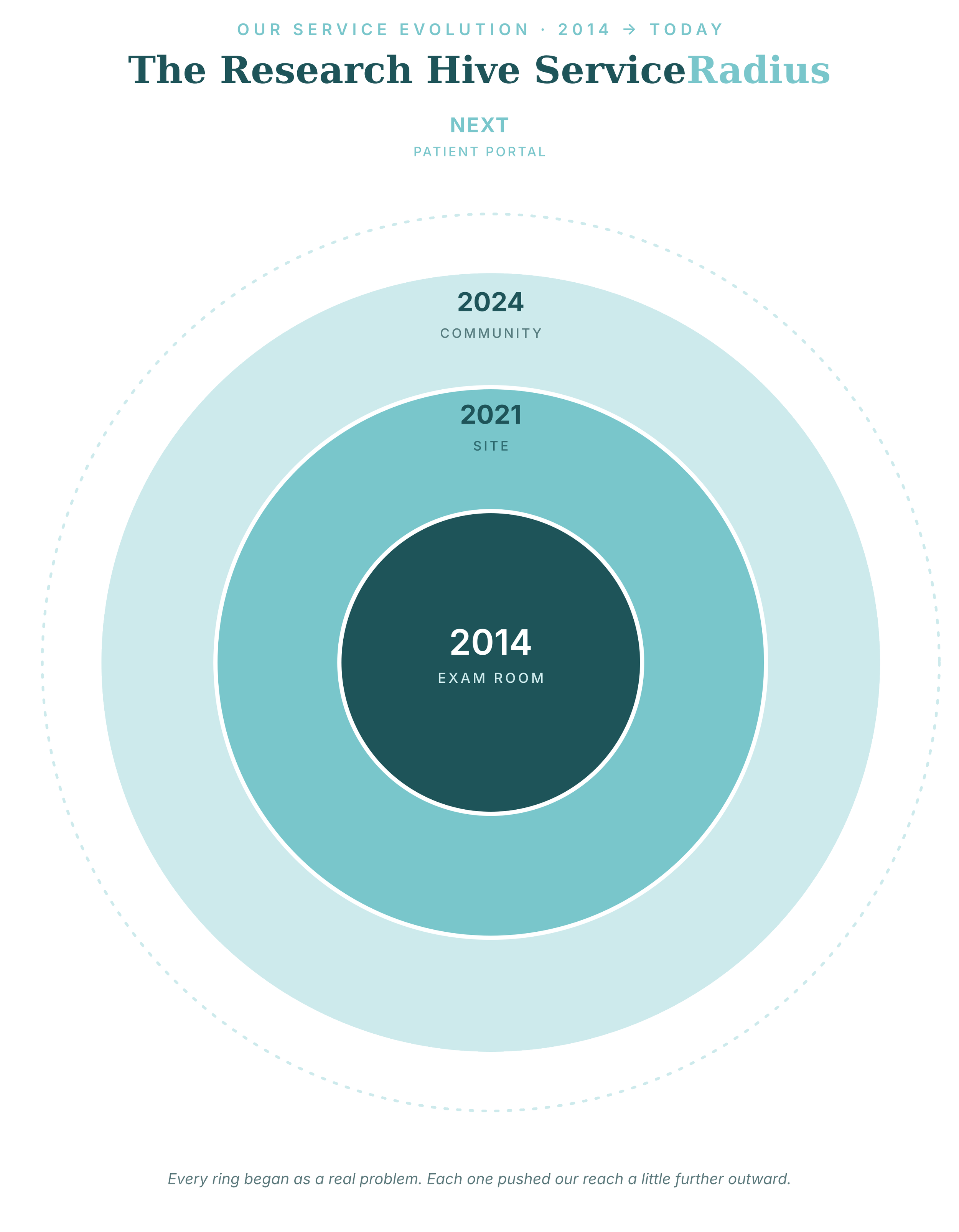
We think about our own history as a set of rings, each one a response to a real problem a site or sponsor brought to us, and each one expanding our reach a little further from where we started.
2014, the exam room. We started with the most fundamental bottleneck in patient recruitment: getting the referral conversation to happen at all. Our mobile and web app put inclusion and exclusion criteria directly in front of physicians and sub-investigators at the point of care, so more candidates got caught in clinic instead of falling through the cracks between visits.
2021, the site. Solving the referral problem exposed the next one: even when physicians wanted to refer, overworked and high-turnover sites often didn't have the coordinator bandwidth to follow through. So we built a CRC support team of experienced coordinators who absorb chart review and data entry for sites that are stretched thin, rather than asking already-maxed-out staff to do more with less.
2024, the community. As enrollment timelines tightened further, it became clear the funnel couldn't stop at the site's front door. Our EP Portal and fair-market-value compensation model extended that same referral pathway outward to community physicians surrounding the site, the ones who see potential candidates every day but have never been part of a formal research network.
What's next: the patient. The next ring is already taking shape: a patient-facing portal built with a CRC verification layer, so patients can engage directly with their own referral and enrollment journey while coordinators stay firmly in the loop, verifying and guiding every step rather than being routed around. It's the natural continuation of the same idea that's driven every ring before it: meet people closer to where they already are, without ever losing the human checkpoint that makes the process trustworthy.
Each ring didn't replace the one before it; it sat on top of it. The mobile app is still the foundation. The CRC support is still running. The community layer is active and growing. And the radius keeps pushing outward from there, exactly as the "still expanding" marks on that diagram suggest.
Why this matters for the partners we work with
We're not sharing this history to be nostalgic. We're sharing it because it's the honest answer to a question every CRO and sponsor should be asking a recruitment vendor: what have you changed in the last few years, and why?
A static tool solves the problem it was built for and nothing else. A partner who treats the field as a moving target, who's willing to rebuild a piece of the funnel when the old approach stops working, is the one who can still be useful to you three protocols from now, not just this one.
Clinical research isn't going to slow down or get simpler. Patient populations will keep getting harder to identify. Sponsor expectations will keep rising. The technology available to meet those challenges will keep changing shape. Our commitment isn't to any one feature or ring on that diagram. It's to keep pushing the radius outward for as long as our CRO and sponsor partners need us to.
That's the only way we know how to stay useful in a field defined by change.